From tapping call
to a scored transcript.
Five steps. Nothing happens off-screen, and each one is designed so you can answer for it later.
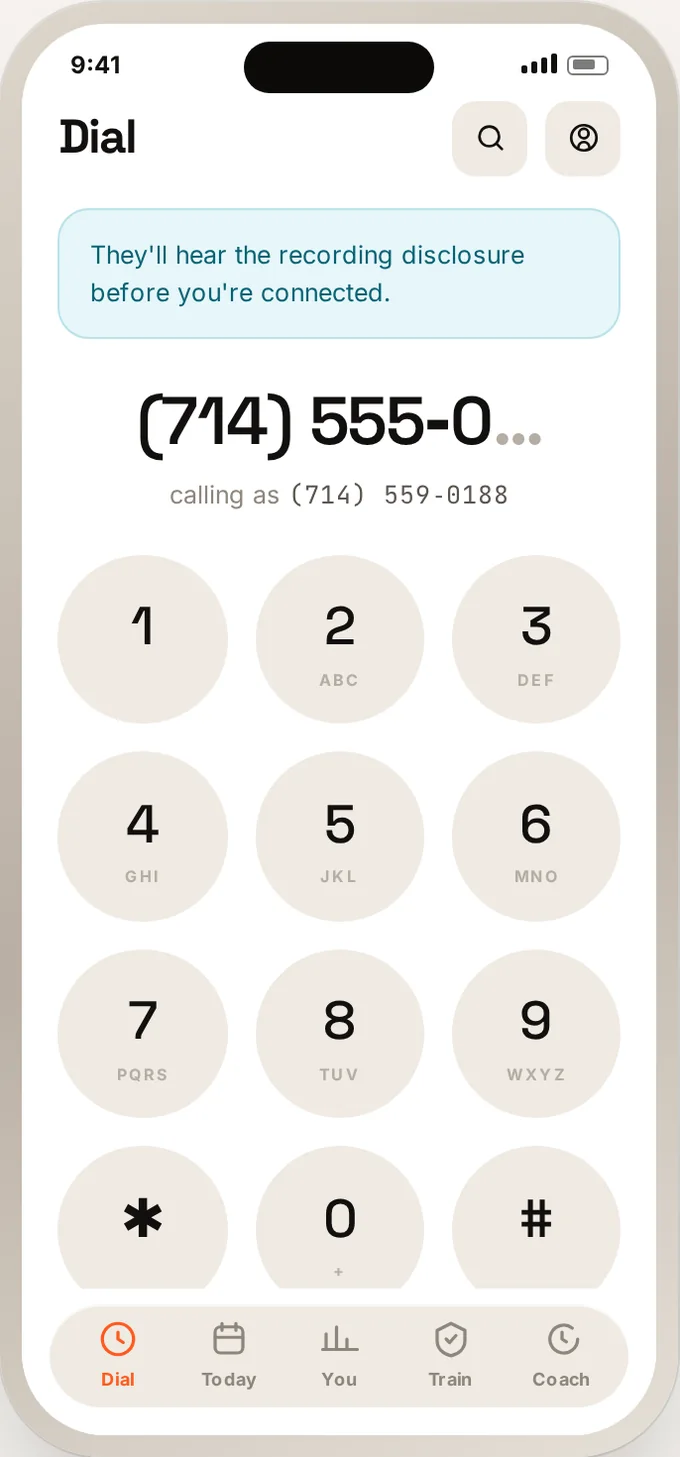
The rep dials from your number.
Calls go out from the Atlas Sales app using your company line as the caller ID — never the rep's personal cell. That's better for the prospect, better for your number's reputation with carriers, and it means the relationship stays with the business when a rep leaves.
Inbound callbacks to your number are captured the same way, rather than being forwarded off to a cell where the recording would be lost.
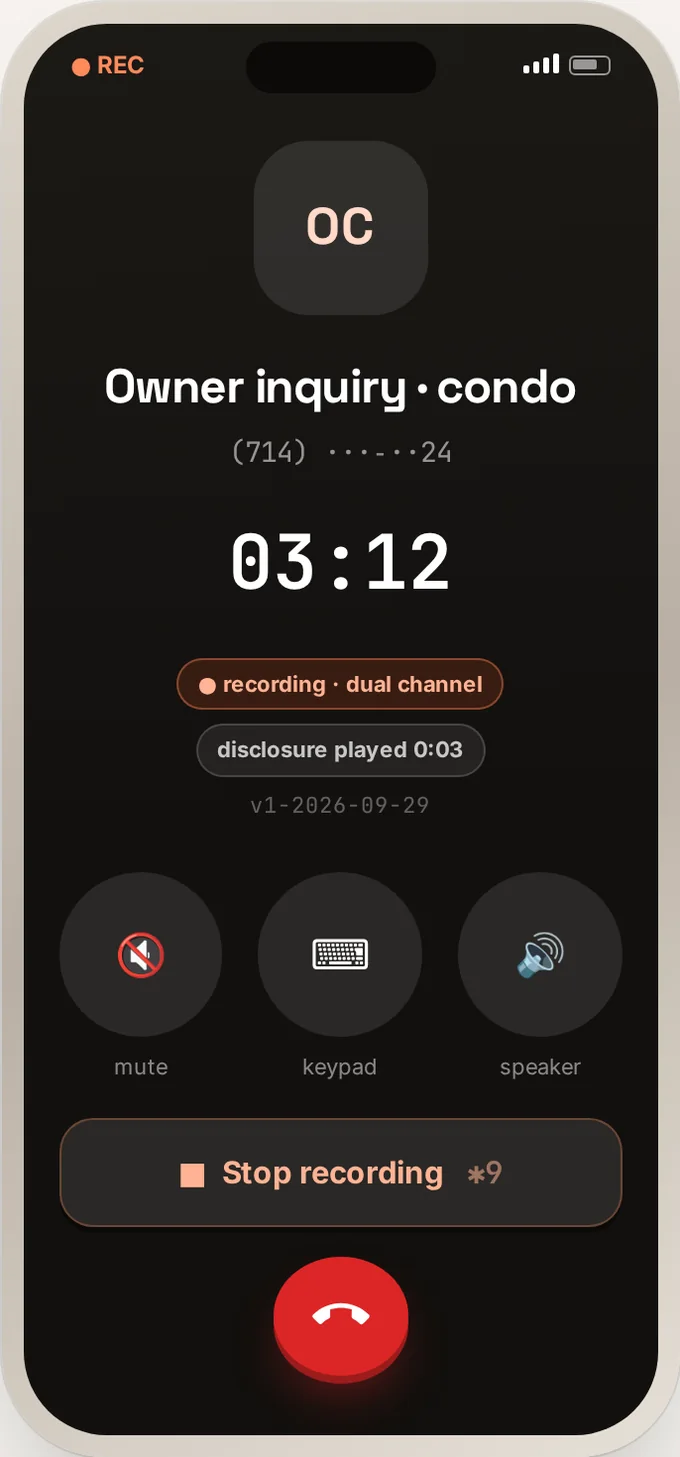
The call is announced, then recorded.
When the other side picks up, they hear a short spoken disclosure. Recording starts after the announcement finishes — the order is enforced in the call flow itself, not left to a toggle.
- Two separate audio channelsRep and prospect are recorded separately, so who said what is a fact rather than a guess.
- The rep can stop itA full-width Stop recording button, plus a keypad code for when the phone is at their ear. If a caller objects, the rep has an answer that isn't "sorry, I can't".
- The wording is keptThe exact disclosure text is stored and can't be quietly rewritten later. Months on, you can still say precisely what a caller was told.
It becomes a transcript you can search.
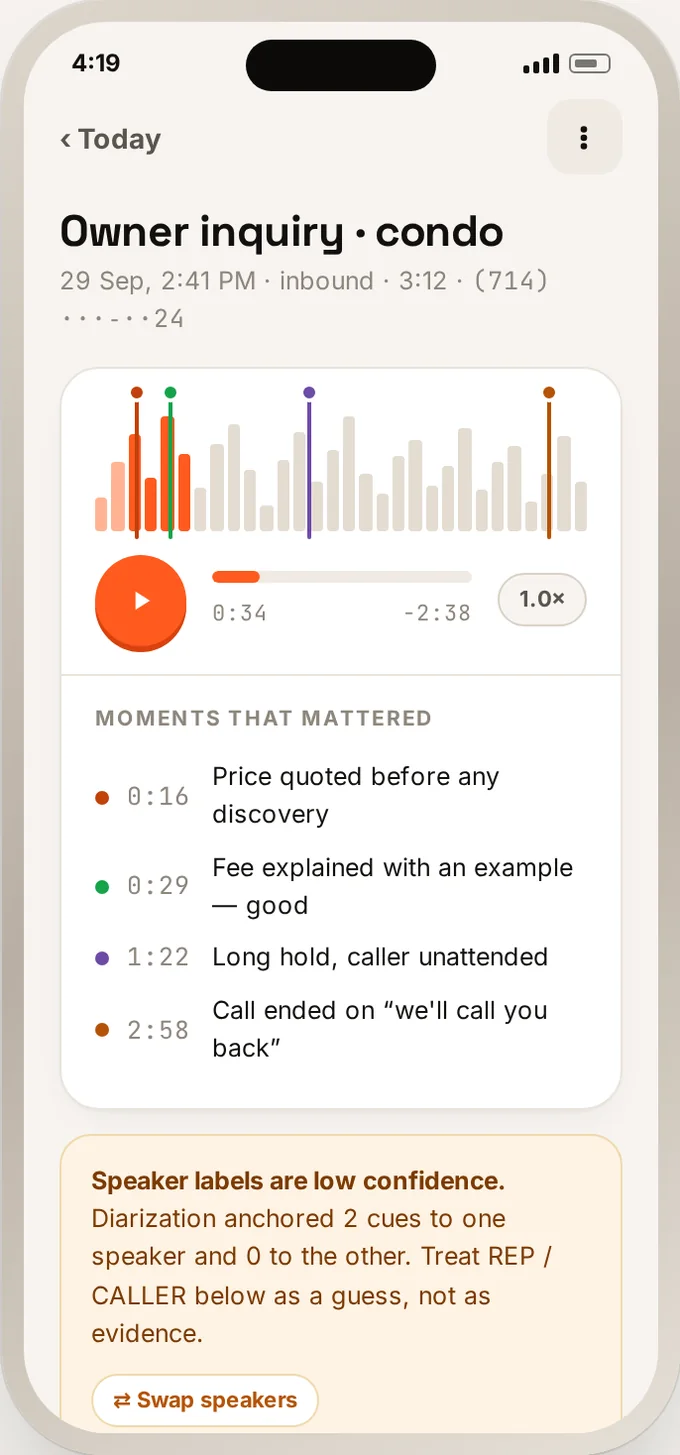
The recording is transcribed and split into speaker-labelled lines. Where speaker attribution isn't reliable, the call says so and offers a one-tap swap rather than presenting a confident label that's wrong.
The waveform carries markers on the moments that were scored, so you can jump straight to them instead of scrubbing through eleven minutes.
It's scored against your rubric.
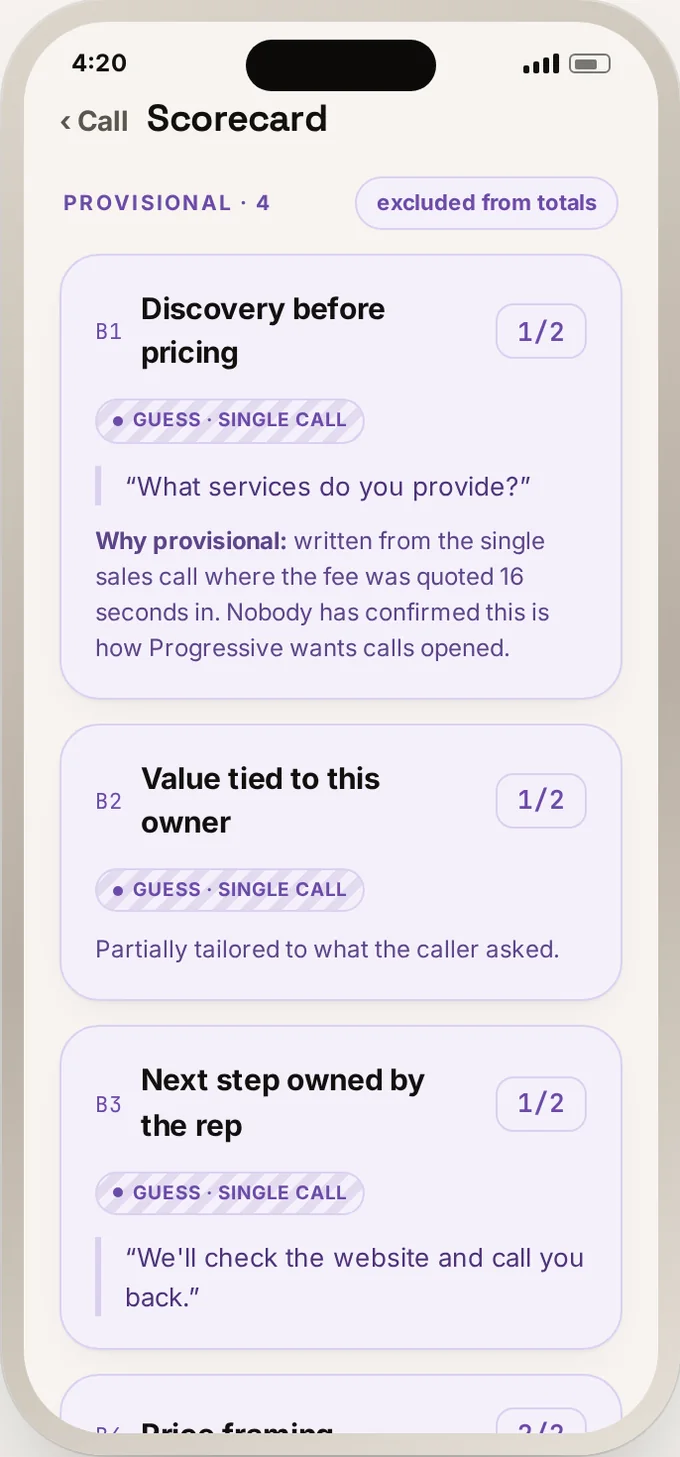
You define the criteria — the handful of things you actually want a rep to do on a call. Each one is scored with the line of transcript that justified it, and carries a confidence level you can see.
- Criteria you haven't confirmed stay provisionalHatched, labelled, and left out of every total and average until a named person signs off on them.
- Rubrics are versionedChange a criterion and you see, before you commit, how many past scorecards it supersedes and which comparisons stop being valid.
- Old scorecards stay readableA re-score supersedes the previous one; it doesn't delete it.
Two people see it, and they see different things.
The same call, the same evidence — but scope is derived from who you are, not from a setting. A rep's browser never receives the manager's view.
The rep sees
- Their own calls, transcripts and scorecards — with the evidence for every mark.
- Their own trend over time. No rep-to-rep comparison exists anywhere in their app.
- Who has listened to their calls, including their manager.
The manager sees
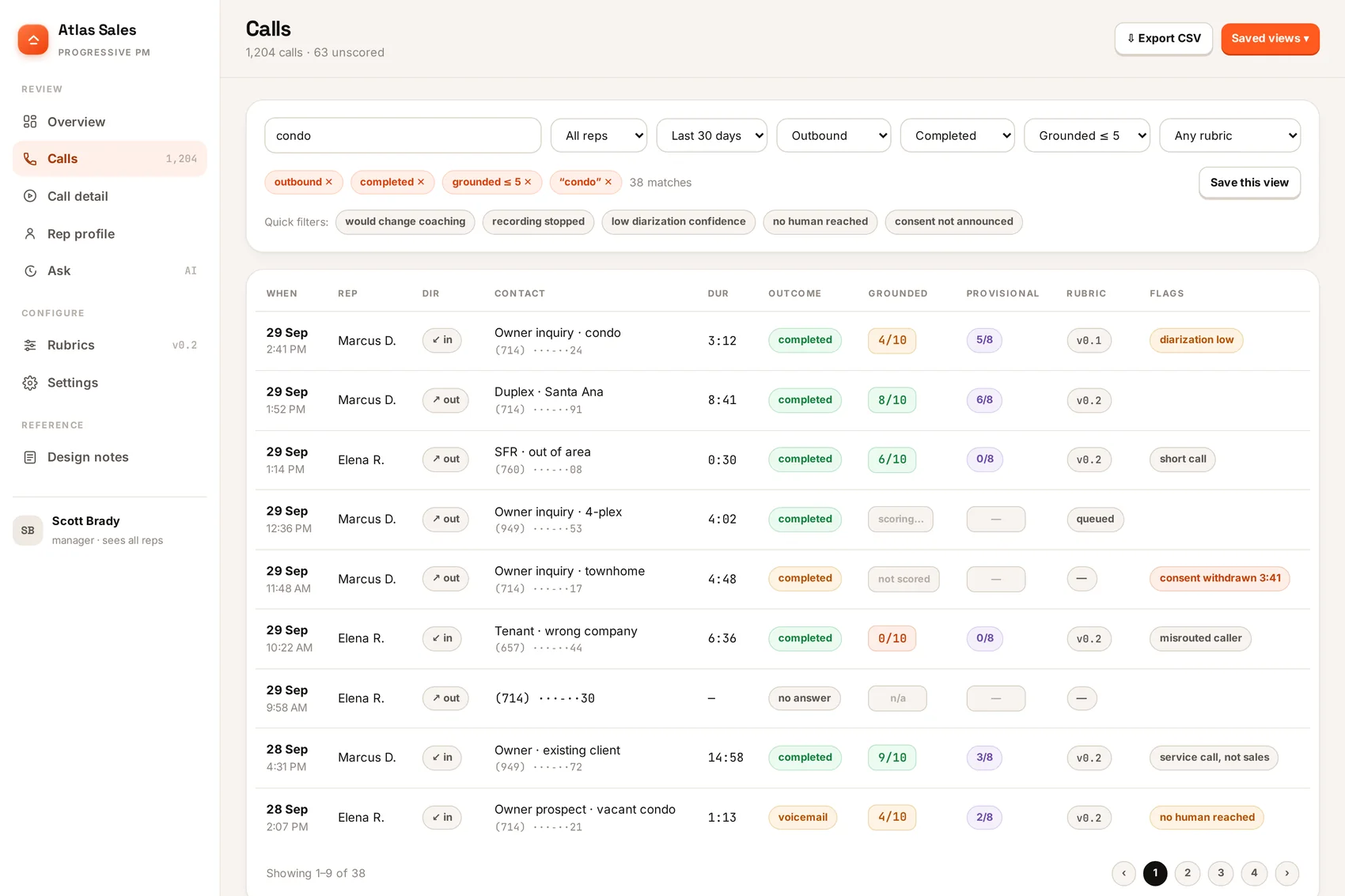
- Every call on the team, filterable by rep, date, outcome and length.
- Where calls are losing points across the team, by criterion.
- Per-rep figures — alphabetical, unsortable, no rank column.
Two decisions worth knowing about
Things we chose not to build.
No leaderboard
Per-rep numbers exist for a manager, sorted alphabetically, with no rank column and score columns that can't be sorted. On a team of two or three, ranking turns a coaching tool into a verdict, and reps stop treating a low score as information. The reason is written on the page inside the product so nobody quietly "fixes" it in six months.
The coach refuses to guess
Ask it something the data can't support — how scores relate to closed deals, say, when nothing links calls to outcomes yet — and it says so and offers what it does have. It also declines to reason from criteria the rubric marks as unconfirmed, even when that would make a tidier argument. A coach that quietly averages guesses gives better-sounding advice and is worth nothing.
Want to see it on your calls?
Twenty minutes in the console, scoped honestly to what works today.